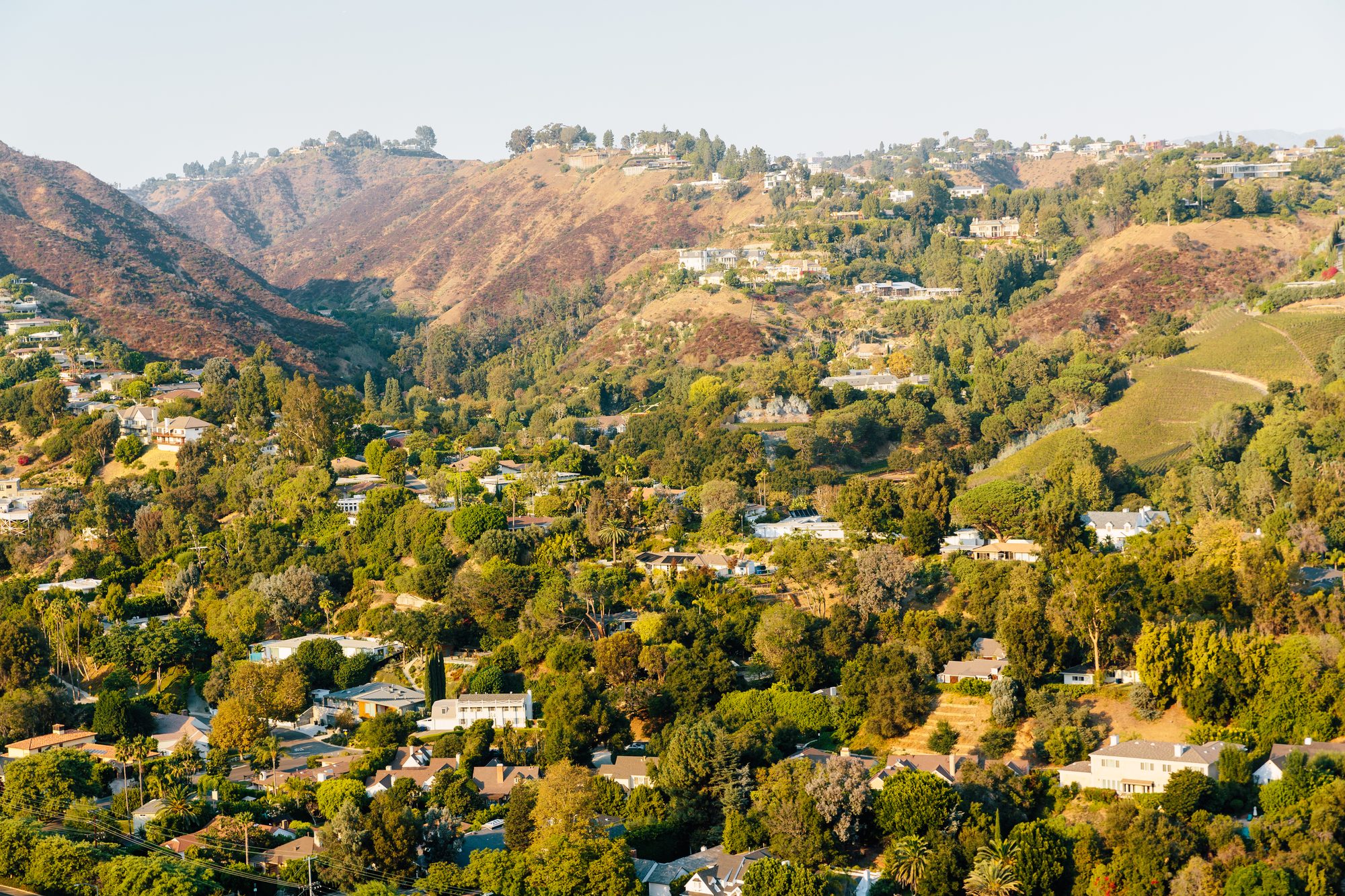
A Red Flag Warning covering the Santa Monica Mountains and foothills above Bel Air and Holmby Hills took effect Tuesday, Aug. 25, and runs through 3 p.m. Saturday, Aug. 29, with forecasters warning of conditions ripe for fast-moving wildfire. The alert arrives as a federal push toward aggressive fire suppression renews a century-old debate over how fires near canyon communities should be fought.
The National Weather Service forecasts highs up to 108 degrees across the lower mountains and foothills of Los Angeles County this week. NWS meteorologist Cody Snell told the Insurance Journal that vegetation was already primed to burn before the heat wave hit, and that any wind at all would be enough to spread fires.
The LAFD has predeployed resources citywide, and the Los Angeles County Fire Department said it was augmenting staffing and pre-positioning personnel ahead of the warning period, according to the Los Angeles Times. Southern California Edison was considering planned power shutoffs for about 5,700 customers, roughly 4,000 of them in Los Angeles County, due to heightened fire risk.
The '10 a.m. rule' and why it matters here
The policy debate centers on the so-called 10 a.m. rule, a U.S. Forest Service mandate created in 1933 that required every wildland fire to be extinguished by 10 a.m. the day after it was reported. The agency abandoned the rule in 1978 after fire scientists recognized what became known as the Wildfire Paradox: decades of snuffing every fire allowed fuel to accumulate, producing larger, more intense blazes that could not be suppressed.
The rule is back in the conversation. Draft versions of President Donald Trump's June 12, 2025, executive order on wildfire prevention and response included language pointing toward a return to full suppression, according to LAist/CalMatters reporting published Aug. 23. The executive order cited the January 2025 Los Angeles wildfires, which killed 31 people, destroyed nearly 12,000 homes and caused an estimated $140 billion in losses.
U.S. Forest Service Chief Tom Schultz reinforced the shift at a July 22 hearing before the House Subcommittee on Forestry and Horticulture, telling Congress that every fire now has a full-suppression strategy and that keeping fires small protects both communities and budgets.
Critics warn of unintended consequences
Not everyone in the firefighting community agrees. Bobbie Scopa, a 45-year firefighting veteran and vice president of advocacy group Grassroots Wildland Firefighters, told LAist/CalMatters that "no one was dumb enough to use 10 a.m. policy language, but there was fear of a fire getting away."
Scopa said the institutional pressure to suppress every fire comes from the personal liability firefighters face when a managed burn escapes.
Megafire Action CEO Matt Weiner told LAist/CalMatters his group successfully pushed to remove full-suppression language from draft versions of the Fix Our Forests Act. Weiner said the goal should not be creating a suppression-only agency, but building a system that puts more beneficial fire on the landscape to reduce fuel loads over time.
What canyon residents should know
The canyons above Bel Air have burned before. The 1961 Bel Air Fire started in Stone Canyon, burned 6,090 acres and destroyed 484 homes, driven by Santa Ana winds gusting up to 100 mph. That fire led Los Angeles to ban wood shake roofs and launch one of the nation's strictest brush clearance programs.
Whether federal policy tilts back toward full suppression or continues allowing managed burns in remote areas, the immediate concern for canyon residents is the current Red Flag Warning. The NWS advises residents near wildland interfaces to be prepared to evacuate if a wildfire breaks out. As we reported Monday, the state recently adopted new Zone 0 fire rules for Bel Air and Beverly Hills canyons.
Residents can sign up for emergency alerts through the city of Los Angeles' NotifyLA system or the Beverly Hills AlertBH system.